ScriptoAI
Occupational therapists were writing reports at night. Now the first draft writes itself.
Visit scriptoai.com.au(opens in a new tab)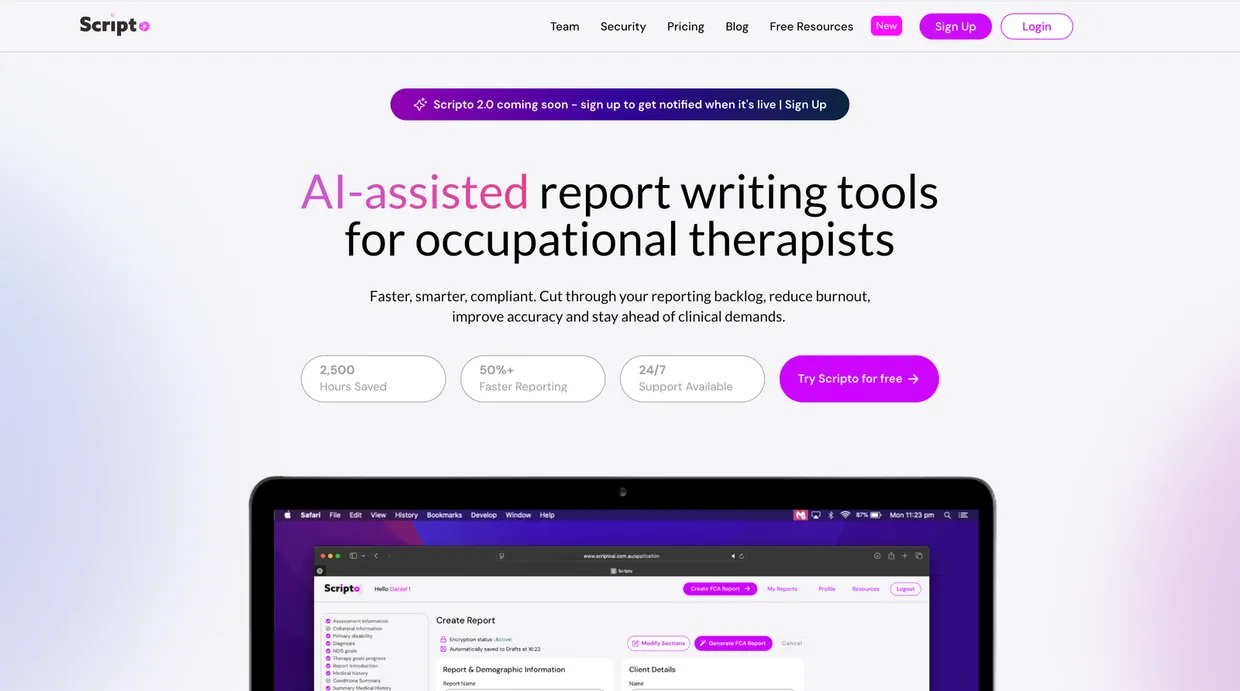
The problem
Occupational therapists were spending their evenings writing reports instead of seeing patients. The clinical thinking took minutes. The writing took hours.
The problem
Occupational therapy reports are long, highly structured, and repetitive in form while being completely specific in content. A therapist finishes a full day of appointments and then starts writing — often at home, often late.
The bottleneck was never the clinical judgement. That part is fast, because it is the part they trained for. The bottleneck was turning judgement into several thousand words of correctly formatted prose, over and over.
What we built
AI-assisted report writing tooling built specifically for occupational therapists — not a general chatbot pointed at a clinical problem.
The tools handle the structure and the first draft, so the therapist starts from something rather than from a blank page. The clinician stays in control of every clinical claim: they review, correct, and approve. Nothing is submitted that a human professional has not signed off.
That distinction mattered more than any feature. In a clinical context, automation that removes the professional from the loop is not a time-saver, it is a liability. The design question was where exactly to draw that line, and we drew it at drafting.
The outcome
The work that needed a clinician still gets a clinician. The typing does not. Reports get finished during the working day, which is the entire point.
The outcome
What actually changed.
Evenings
handed back to the clinician
Minutes
to a first draft, not hours
Clinician
stays the author and the approver